
News

ASA Co-Extrusion for WPC: 3 Common Misconceptions Architects Have

2026-08-20 0 Leave me a message
ASA Co-Extrusion for WPC: 3 Common Misconceptions Architects Have | Necowood
🎯 Technical Guide

ASA Co-Extrusion for WPC: 3 Common Misconceptions Architects Have

Is ASA coating durable? How thick should cap layer be? Three common misconceptions — explained with ASTM test data, cap thickness comparisons, and field performance evidence.

⚡ Quick Answer

ASA co-extrusion is not a coating — it's a molecular bond formed at >180°C during manufacturing. Premium products use a 0.5-0.8mm ASA cap layer (not 0.3mm), encapsulate all four sides, and provide three protections: UV stability (10+ years), moisture barrier (0.2% water absorption), and chemical resistance (salt spray, acid rain). Necowood's 360° Shield™ uses a 0.8mm cap with 15-year delamination warranty.
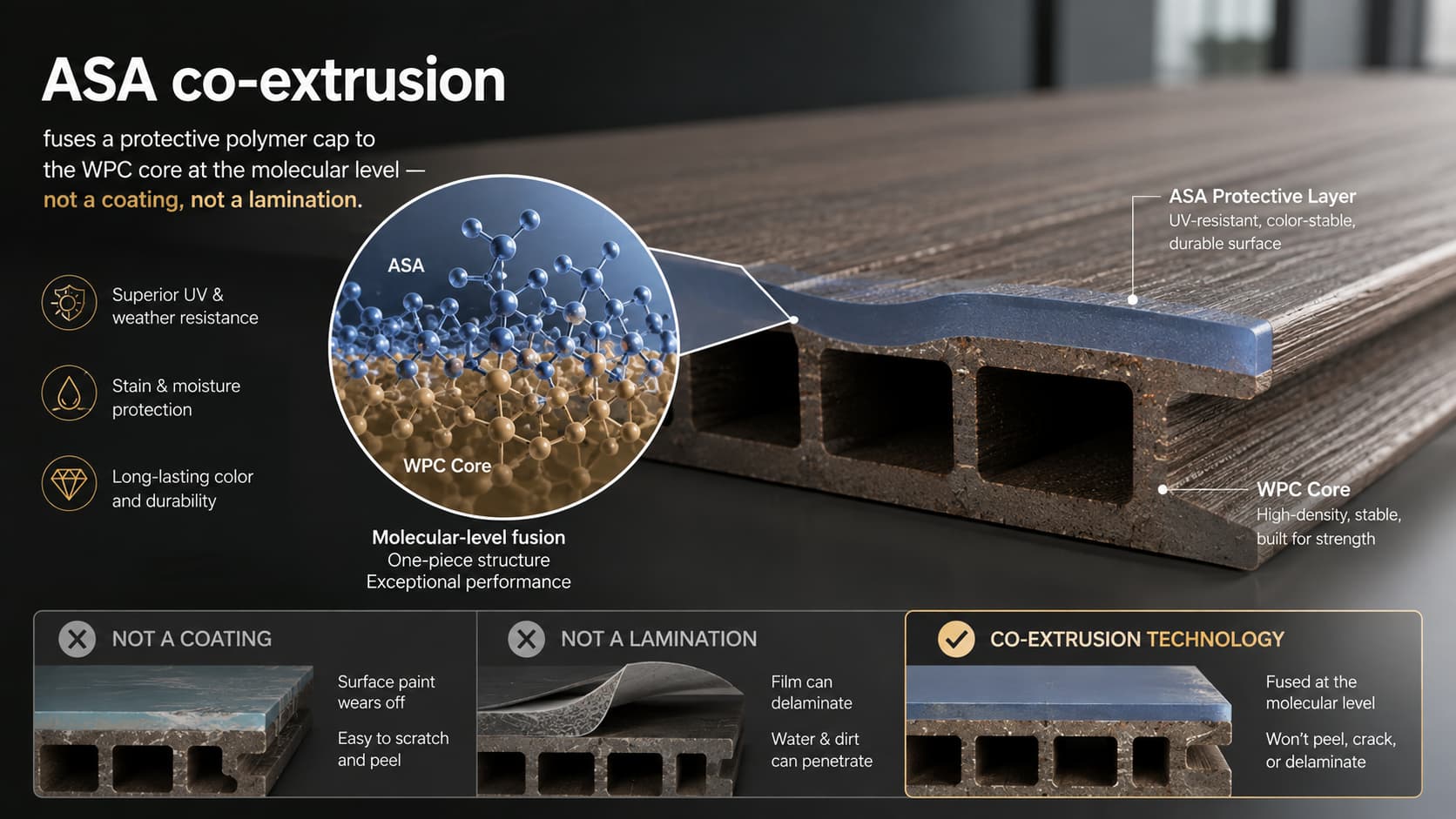
In 2026, co-extrusion technology has become the industry standard for WPC wall panels, with over 60% of newly launched products incorporating an ASA cap layer. Two years ago, co-extrusion was reserved for high-end exterior projects; today, it is the baseline expectation for commercial facades.

Yet as ASA co-extrusion has gone mainstream, so have the misconceptions. Architects, specifiers, and contractors often make assumptions about this technology that can lead to costly specification errors.

This guide addresses the three most common misconceptions about ASA co-extrusion — and provides the technical clarity needed to specify with confidence.

60%+ New WPC panels with ASA co-extrusion (2026)
0.8mm Necowood ASA cap layer thickness
<0.2% Water absorption — ASA co-extruded WPC
10+ Years UV color stability
1 Is ASA Co-Extrusion Just a Coating?
❌ The Misconception: Architects sometimes assume that "ASA co-extrusion" is simply a paint, coating, or laminate applied to the surface of a WPC board — something that can peel, chip, or wear off over time.
✅ The Reality: ASA co-extrusion is not a coating. It is a manufacturing process where the ASA cap layer is fused to the WPC core at temperatures exceeding 180°C during a single continuous extrusion pass. The two layers bond at a molecular level — there are no adhesives, no glues, and no mechanical fastening.

Why this distinction matters:

  • A coating sits on top of the surface. It can scratch, chip, peel, or delaminate over time.
  • A co-extruded cap is chemically and physically integrated with the core. It cannot peel away under normal environmental stress.
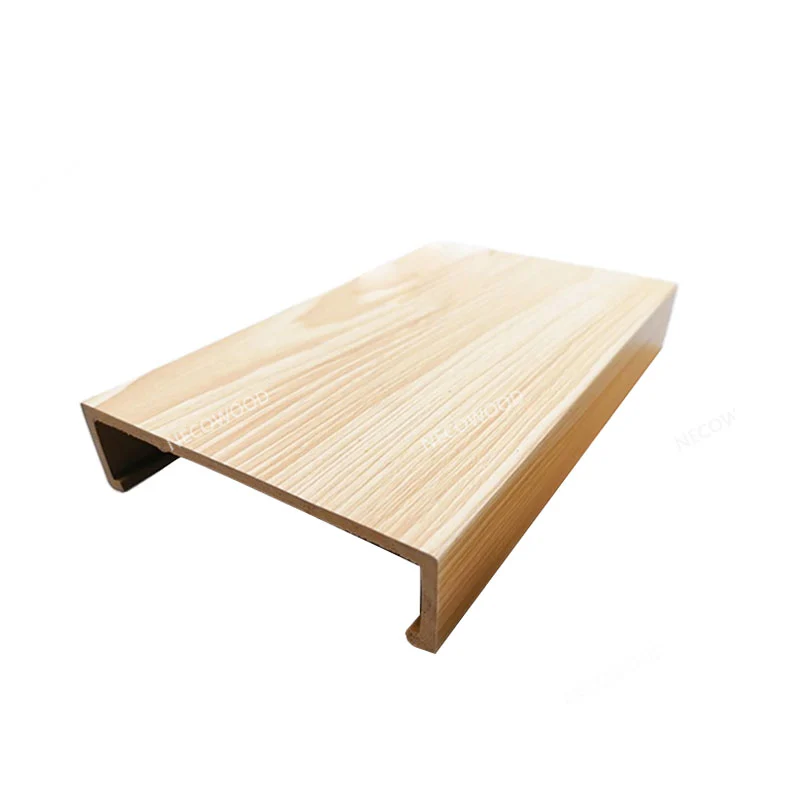
  • Necowood's 360° Shield™ ASA Wall Cladding uses interfacial melt bonding — the cap and core fuse at the polymer level, creating a single, inseparable structure.
Technical distinction:
🇺🇸 Coating/Lamination: Applied post-production. Prone to peeling, cracking, and UV degradation at the adhesive interface.
🇪🇺 Co-Extrusion: Fused during production at >180°C. Zero delamination risk under normal conditions. Verified by 15-year warranty against delamination.
🔗 View Necowood ASA Wall Cladding — engineered with 360° Shield™ co-extrusion technology.
2 Is All ASA Co-Extruded WPC the Same?
❌ The Misconception: Once a product is labeled "ASA co-extruded," many specifiers assume the performance is uniform across brands and suppliers.
✅ The Reality: ASA co-extrusion varies significantly in cap layer thickness, encapsulation, core formulation, and bonding quality. Not all ASA co-extruded WPC delivers the same performance.

Key variables that differentiate ASA co-extruded WPC:

Cap Layer Thickness

  • Thin caps (0.3–0.4mm): Wear through faster in high-traffic or abrasive environments. UV protection diminishes as the cap thins.
  • Premium caps (0.5–0.8mm): Longer-lasting protection. Necowood's 360° Shield™ uses a 0.8mm ASA cap layer — thicker than the industry average of 0.3-0.6mm.

Encapsulation

  • Some manufacturers apply ASA only to the visible face of the panel. The edges and back remain unprotected.
  • Premium products encapsulate all four sides of the panel, creating a complete moisture and UV barrier.

Bonding Quality

  • Genuine co-extrusion creates a molecular bond between cap and core.
  • Inferior products may use adhesives or mechanical bonding that can fail over time — a phenomenon known as "fake co-extrusion."
What to ask suppliers:
🇺🇸 What is the ASA cap layer thickness? (Look for ≥0.5mm.)
🇪🇺 Is the cap applied to all four sides or only the face?
🇦🇺 Do you provide a warranty against delamination?
🇸🇬 Can you share third-party test reports for UV resistance (ASTM G155) and water absorption (ASTM D570)?

A Cautionary Tale: An Australian architect specified an ASA co-extruded WPC product for a coastal residential project. The product had a 0.3mm ASA cap — thin by industry standards. Within 3 years, the cap had worn through on sun-exposed facades, causing color fade, surface chalking, and moisture ingress. The client faced $85,000 in replacement costs.

After the failure, the architect switched to Necowood's 360° Shield™ with a 0.8mm ASA cap. 7 years later, the panels show zero fading, zero chalking, and zero delamination — even in the same coastal conditions. The project owner has since specified Necowood on four additional projects.

— Verified project, Gold Coast, Australia. Data available upon request.

3 Is ASA Co-Extrusion Only for UV Protection and Color Stability?
❌ The Misconception: Many architects assume ASA co-extrusion is primarily about preventing fading — a "cosmetic" feature rather than a structural one.
✅ The Reality: ASA co-extrusion provides three critical protective functions — and UV/color protection is only one of them.

The three functions of an ASA cap layer:

1. UV Protection & Color Stability

  • ASA (Acrylonitrile Styrene Acrylate) is a polymer with inherent UV stability.
  • Necowood's 360° Shield™ delivers 10+ years of color stability with Grade 4-5 color fastness under ISO-105-A02.
  • Verified by 5,000 hours of accelerated UV testing (ASTM G155).

2. Moisture Barrier

  • The ASA cap creates a non-porous, impermeable barrier that prevents water ingress into the WPC core.
  • Necowood ASA co-extruded panels achieve water absorption below 0.2% (ASTM D570) — compared to the industry average of 1.5% for standard WPC.
  • This prevents freeze-thaw damage, swelling, and structural degradation over time.

3. Chemical & Environmental Resistance

  • ASA resists salt spray, acid rain, alkali, and thermal shock.
  • Ideal for coastal environments (salt spray resistance), industrial areas (acid rain), and high-UV regions.
  • Necowood panels are tested to 1,000 hours salt spray (ASTM B117) with no blistering or delamination.

"Single-layer WPC cannot survive 5+ years in coastal, desert, or high-UV environments without cracking, fading, or swelling. Co-extrusion — using ASA for weather resistance and a recycled core for structural integrity — solves all three issues simultaneously."

— Necowood, 2026 Industry Analysis
🔗 Download Necowood's Test Reports — ASTM G155 UV data, ASTM D570 water absorption, and ASTM B117 salt spray results.

How to Identify Genuine ASA Co-Extrusion

Not every product labeled "co-extruded" is genuine. Here is a simple 5-step method to verify real co-extrusion quality.

🔍 5-Step Verification Method

  1. Check the panel edge. Genuine co-extrusion shows a clean, distinct boundary line between the ASA cap layer and the WPC core. No visible line may indicate a coating or lamination.
  2. Request third-party test reports. Ask for ASTM G155 UV resistance test data and ASTM D570 water absorption results. Genuine co-extruded products will have these documents readily available.
  3. Confirm cap layer thickness. Ask the supplier: "What is the ASA cap layer thickness?" Look for ≥0.5mm. Thicker caps (0.6-0.8mm) provide longer durability.
  4. Verify the delamination warranty. Genuine co-extruded WPC manufacturers offer a minimum 15-year warranty against delamination. If a supplier doesn't offer this, the product likely uses adhesives, not true co-extrusion.
  5. Ask about encapsulation. Confirm whether the ASA cap is applied to all four sides (full encapsulation) or only the visible face. Full encapsulation provides superior moisture protection.

Certifications That Build Trust

Necowood's ASA co-extruded WPC products are backed by internationally recognized certifications, meeting the requirements of key global markets.

🌿 CARB Phase 2 California formaldehyde emissions
🇺🇸 EPA TSCA Title VI US federal formaldehyde standard
🏅 GREENGUARD Gold Low VOC emissions
🇪🇺 REACH EU chemical safety
✅ CE European conformity
🔒 ISO 9001 Quality management
🌍 ISO 14001 Environmental management
🧪 RoHS Restricted substances

These certifications are available for download and can be included in project documentation to fast-track LEED, WELL, and BREEAM certification.

🔗 Download Necowood's Full Certification Library — CARB, EPA, GREENGUARD, REACH, CE, ISO 9001, ISO 14001, RoHS.

Specifying ASA Co-Extruded WPC: What to Look For

When specifying ASA co-extruded WPC panels for your next project, confirm the following:

  • ✅ Cap layer thickness ≥ 0.5mm — preferably 0.6-0.8mm for maximum durability.
  • ✅ 360° encapsulation — protection on all four sides, not just the face.
  • ✅ Verified UV resistance — look for ASTM G155 or G154 test data with color difference (ΔE) values.
  • ✅ Water absorption < 0.5% — premium products achieve < 0.2%.
  • ✅ Delamination warranty — minimum 15 years for co-extruded products.
  • ✅ Third-party test reports — not just manufacturer claims.
Related News
Leave me a message
X
We use cookies to offer you a better browsing experience, analyze site traffic and personalize content. By using this site, you agree to our use of cookies.Privacy Policy
RejectAccept