







QR Code

Contact Us


Email

Address
Nantongbang Industrial Park, No. 80, Fumin Road, Yuanshanbei Village, Changping Town, Dongguan City, Guangdong, China


Geopolitics, Price Surge & Procurement Strategy — A Data-Driven Guide for Specifiers and Buyers
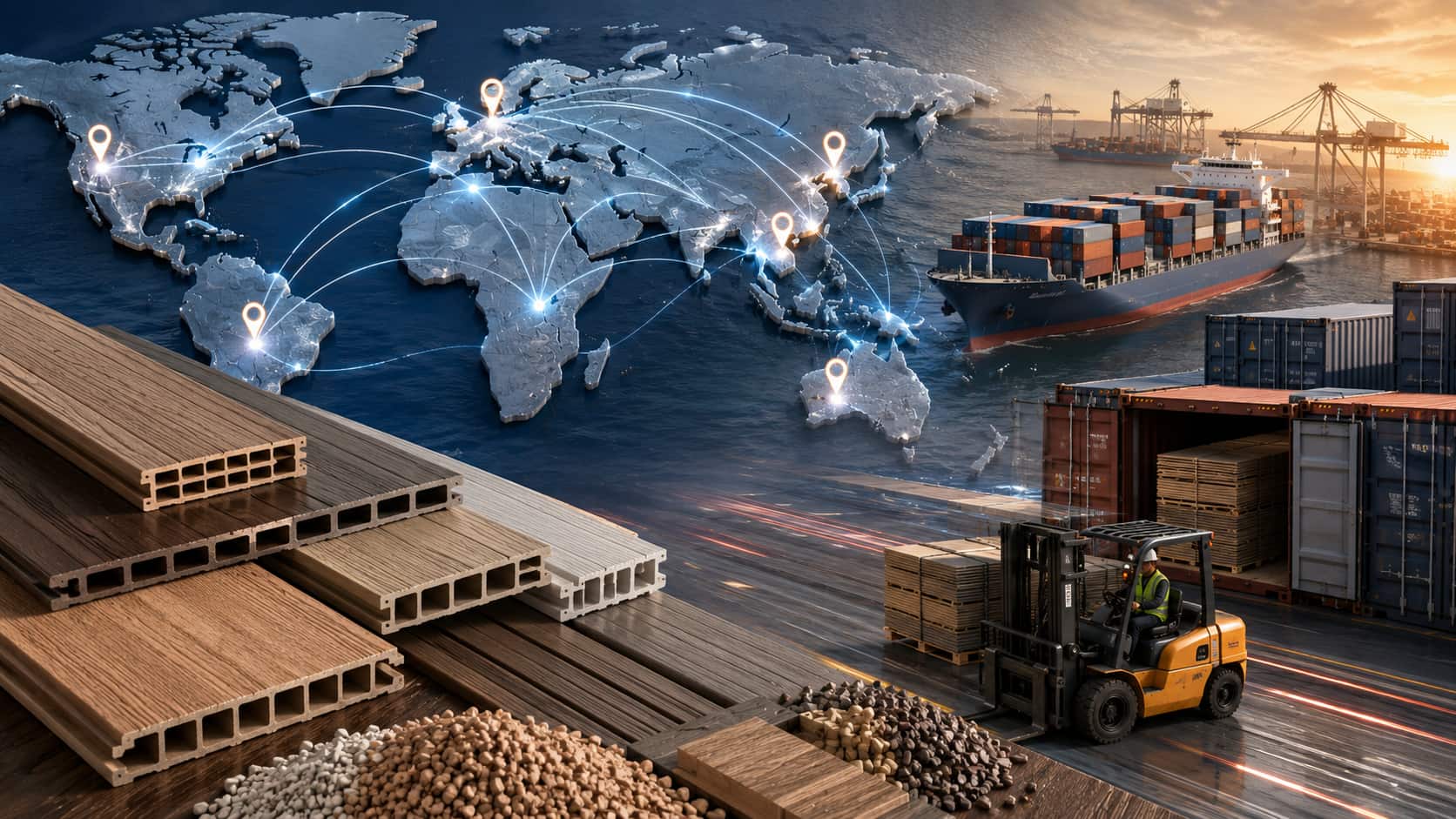
2026 is the year the WPC supply chain broke.
Not gradually. Not predictably. In a matter of weeks, three concurrent shocks — Middle East conflict, a looming EU regulatory wall, and the wholesale restructuring of global trade routes — have transformed WPC procurement from a routine purchasing decision into a high-stakes supply chain chess match.
For procurement directors, specifiers, and distributors, the question is no longer "which WPC product should I buy?" It's "can I get WPC at all — and at what price?"
This is not a market outlook. This is a crisis map — a data-driven analysis of what's happening, why it matters, and how to secure your WPC supply in 2026.
The WPC industry has weathered disruptions before. But 2026 is different. Three independent shocks converged simultaneously, creating a supply chain crisis without precedent in the composite materials sector.
The Middle East conflict has effectively choked the Strait of Hormuz, a critical maritime chokepoint through which approximately 30% of the world's seaborne oil and a significant portion of petrochemical shipments pass. Global shipping firms are redesigning trade routes, reducing Gulf port calls, and redirecting cargo through costly workarounds.
"The Strait of Hormuz blockade and Middle East tensions have spiked medical device input costs by nearly 50% for plastics and doubled PNG gas prices used for power generation."
— The Times of India, March 2026The impact on WPC feedstocks has been immediate and severe. HDPE prices surged from $1,003/ton to $1,356/ton FAS Houston in just three weeks[1] — a $353/ton increase that rippled through the entire WPC value chain. By April 2026, global average HDPE spot prices had skyrocketed to $1,720/MT, a 75.5% increase from January[2].
Effective November 21, 2026, the European Union will ban all exports of plastic waste to non-OECD countries[3]. This is not a minor regulatory tweak — it's a structural shift in the global recycled plastics market.
For WPC manufacturers outside the EU who rely on European recycled HDPE as feedstock, this ban represents a supply shock of the first order. The regulation will significantly increase the amount of plastic waste to be recycled within the EU, tightening global supply and intensifying competition for recycled polymer feedstocks[3]. Recycling facilities outside the EU that process European waste will face independent third-party audits.
Global trade is undergoing its most significant transformation since the first Gulf War. The era of "just-in-time" logistics, optimized purely for cost efficiency, is giving way to a new paradigm: supply chain security at any cost.
Red Sea diversions are now a permanent feature for many shipping lines[4]. Major carriers are accepting longer routes around the Cape of Good Hope as a long-term operational reality[4]. The global trade system, overly reliant on concentrated supply routes, is being forced to diversify.
"Disruptions in the straits are forcing global trade to shift from efficiency to a 'recovery at all costs' approach through diversified corridors."
— Vietnam.vn, May 2026Numbers on a screen don't capture the reality. Here's what the supply chain crisis actually means for WPC buyers:
The result? A "geopolitical tax" that has pushed raw material costs for HDPE and PP to multi-year highs[5]. Spot market availability has tightened critically, with price hikes reaching 35–55 cents/lb in key industrial regions.
Supply chain risk is not evenly distributed. Understanding regional vulnerabilities is essential for geographically diversified procurement.
Risk Level: High
Manufacturing heartland, but heavily dependent on imported polymer feedstocks. Chinese WPC manufacturers buying HDPE on spot are seeing prices move from a Q4 2025 baseline of ~$1,074/MT toward the $1,200–$1,300/MT range.
⚠️ High ExposureRisk Level: Medium-High
Houston has become a critical hub, but volatility is extreme. HDPE FOB Texas surged 36.57% in early March[1]. The Port of Houston is seeing a "short-term sharp rise" in chemical shipments as trade routes restructure.
⚠️ High VolatilityRisk Level: Medium
Regulatory tightening is the primary driver. The November 2026 waste export ban will restrict recycled feedstock availability[3]. However, the EU's push for circular materials may create new local supply sources over time.
📋 Regulatory ShiftRisk Level: Critical
Directly in the path of the crisis. HDPE and LLDPE prices have seen significant increases since March 2026[1].
🚨 Crisis EpicenterIn a disrupted market, passive procurement is a recipe for failure. Here is a four-step framework for active supply chain management:
In a market defined by uncertainty, Necowood's supply chain is built for stability.
With 16+ years of WPC manufacturing experience and exports to 35+ countries, Necowood has developed a vertically integrated supply chain that insulates customers from the worst of the current disruption.
As the WPC market structurally shifts toward high-performance, regulation-ready materials, manufacturers with resilient supply chains will lead the market. Necowood is committed to being that partner — delivering innovative products, documented performance, and supply chain reliability when it matters most.
Necowood supply chain data is proprietary and available upon request.
Nantongbang Industrial Park, No. 80, Fumin Road, Yuanshanbei Village, Changping Town, Dongguan City, Guangdong, China